
For many pet owners, having insurance for their cat or dog is about preparing for unexpected veterinary expenses.
But not all pet insurance policies are structured the same way. We compared three pet insurance options in Singapore – Income Happy Tails, MSIG PawEasy and Liberty PetCare. Here are some of the key areas our pet owners usually considered before making their purchase decision.
The biggest differences are not necessarily the premiums.
They are in what happens when your pet actually needs treatment.
🟠 Income – Happy Tails
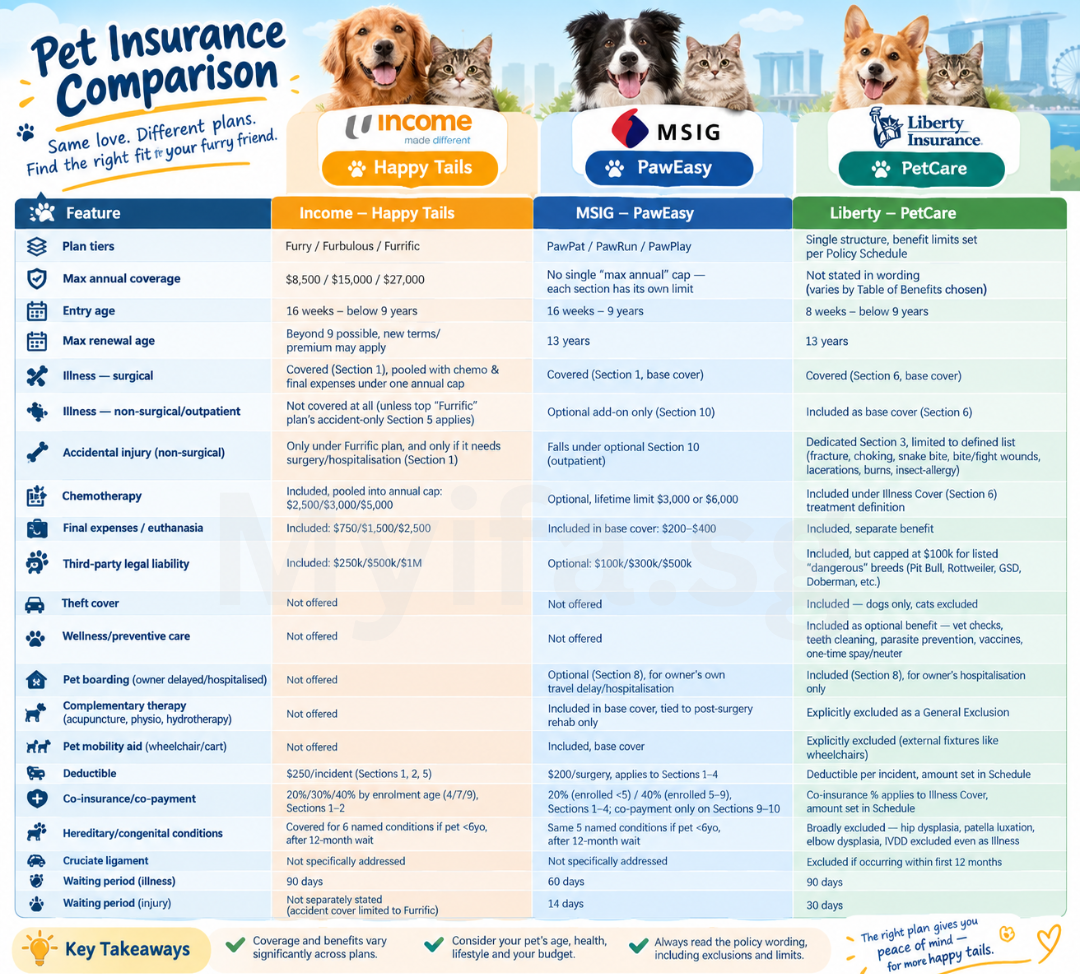
Income Happy Tails offers three plan tiers: Furry, Furbulous and Furrific, with annual coverage limits of $8,500, $15,000 and $27,000 respectively.
Its coverage is more focused on major medical events. Illness-related surgical treatment is covered, while non-surgical/outpatient treatment is generally not covered under the plans described, subject to the specific benefits.
Third-party liability is included, with limits ranging from $250,000 to $1 million.
A notable feature is the inclusion of chemotherapy and final expenses within the relevant annual limits.
🔵 MSIG – PawEasy
MSIG PawEasy also offers three tiers: PawPat, PawRun and PawPlay.
Rather than one overall annual limit, the policy has different limits for different sections of cover.
PawEasy provides base cover for illness-related surgery and includes benefits such as post-surgery complementary therapy and mobility aids. Outpatient treatment is available as an optional add-on.
It also offers optional third-party liability and pet boarding benefits, while chemotherapy can be added with a specified lifetime limit.
🟢 Liberty PetCare
Liberty PetCare takes a different approach with a single policy structure, with benefit limits determined by the Policy Schedule.
One of the key differences is that non-surgical illness treatment is included as base cover, rather than being an optional add-on.
PetCare also provides some benefits not shown under the other two plans, including theft cover for dogs and an optional wellness/preventive-care benefit.
However, its policy wording also contains specific exclusions, including certain hereditary conditions and complementary therapy.
There is no “one-size-fits-all” pet insurance. The comparison shows that the three plans have different coverage structures and priorities.
One may provide stronger protection for major medical expenses, another may offer more flexibility through optional benefits, while another may include broader illness-related treatment as part of its base coverage.
The important question is therefore not simply:
“Which policy is cheapest?”
Instead, ask:
“What risks do I want my pet insurance to cover and how much am I prepared to pay myself?”
For pet owners, insurance is ultimately about managing financial uncertainty while ensuring that unexpected veterinary expenses do not come as a complete surprise.
🐾 Because they’re family, it’s worth understanding the cover before you need it.
Below show the summary of the plans discussed.
Making sense of pet insurance will provide more insights to the Terms & Conditions.
Should you need an advice on Pet Insurance, drop us a message via WhatsApp.
Disclaimer: This comparison is for general educational purposes and is based on the policy information provided for comparison. Benefits, limits, exclusions, waiting periods, deductibles, co-insurance and eligibility conditions may change. Always refer to the latest policy wording, benefit schedule and insurer’s terms before making a decision.
 My IFA@Sg