
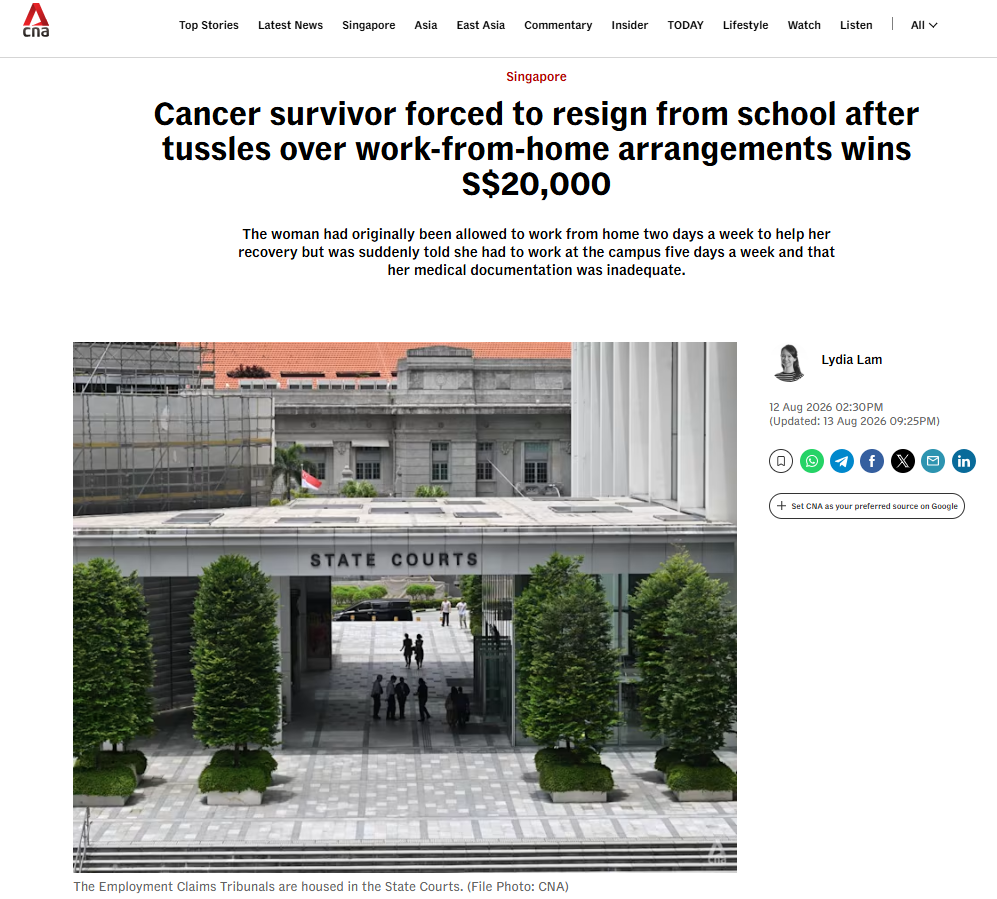
A S$20,000 tribunal case in Singapore highlights a financial risk many working adults overlook: your income can be vulnerable even when you still have a job.
In August 2026, Singapore’s Employment Claims Tribunal awarded a woman S$20,000 , the maximum it could award, after finding that she had been effectively forced to resign from her job at an international school. Although she resigned on paper, the tribunal found that her resignation amounted, in substance, to a dismissal without just cause or excuse.
The tribunal found that the employer had failed to genuinely engage with her medical circumstances, and that her resignation amounted to a dismissal without just cause or excuse. It’s a case about employment law. At first glance, this looks like an employment dispute. But there is a deeper financial-planning lesson – what happens, financially, in the months when illness makes someone unable to work as they once did and no one has planned for it?
Insurance cannot replace proper HR policies, genuine medical accommodation, or honest communication between an employer and an employee. In this case, the tribunal’s findings were about the failure to consider reasonable alternatives and a documentation policy used as a pretext to avoid a harder conversation. No insurance product fixes that.
What insurance can do is provide financial resources when illness creates financial consequences for the employee, and separately, for the business. It’s a risk-management tool, not a substitute for how people are treated.
Protecting the Employee
From the employee’s perspective, a serious illness creates two pressures at once. The direct and almost immediate pressure is higher expenses due to medical treatment and medication. The indirect pressure and this usually comes later is lower income when the employee may not be able to work the same hours or prefers to take a less stressful job to recuperate.
In my 20 odd years in financial advisory, I always stress on the scenario mentioned in the news. Many individuals always felt they are well protected because they are employed and enjoyed sufficient insurance coverage from their employer. Looking back, the lady wasn’t unemployed during her ordeal. She had a job and a fixed salary. But her financial stability depended entirely on a workplace relationship that was breaking down and she was left with what the tribunal called an “unenviable dilemma” in the end. She had to choose between staying employed and risk her health, or resign and protect it.
This is where different forms of protection, as shown below) can play distinct roles, and shouldn’t be treated as interchangeable.
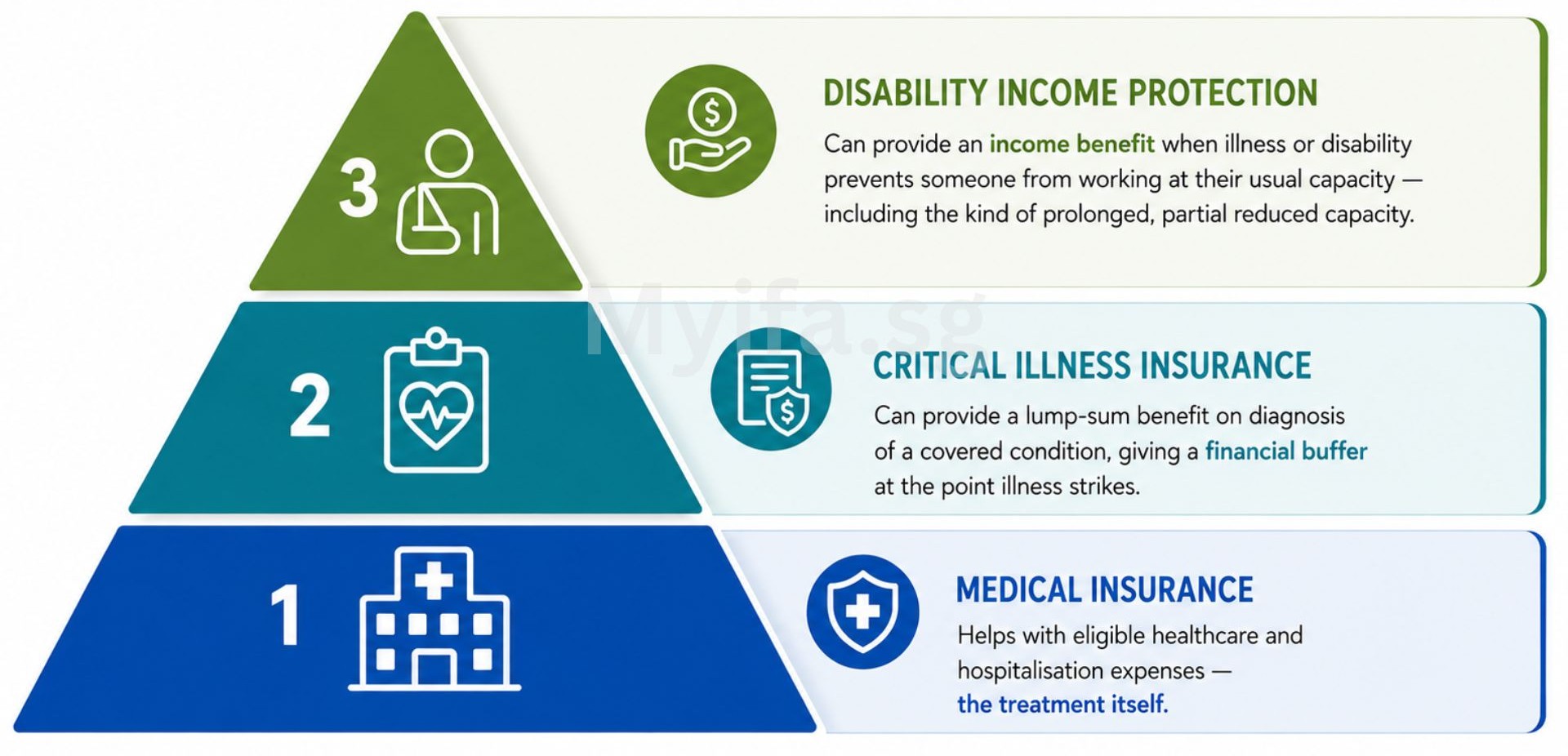
A Critical Illness(CI) plan pays out once, in a lump sum, only when a condition reaches a defined severity threshold e.g. cancer that has spread, advanced organ failure, and so on. That structure assumes illness is a single event: diagnosis, payout, done. In the case mentioned in news, it shows how misleading that assumption can be. Her illness was a long, uneven process from diagnosis, months of treatment, a “fit to return” that didn’t mean fully recovered, and a further year of complications that her own oncologist eventually called “probably permanent.” A single-payout plan tied to the most severe stage of illness would have already paid out (or not yet triggered) long before the financial pressure of her workplace dispute even began.
This is where more comprehensive CI plan can help close the gap:
- Early-stage coverage pays when a condition is caught before it meets the traditional “full severity” CI definition. Many critical illness are often first picked up through earlier symptoms especially if once does annual medical checkup. Early-stage coverage means money in hand while the diagnosis is still being confirmed and treatment options are being decided, rather than waiting for the disease to progress further.
- Intermediate-stage coverage sits between early and full-stage for conditions more advanced than “early” but not yet meeting the traditional full CI threshold. It reflects the reality, that illness rarely moves in two neat steps but it progresses, and financial pressure builds well before the most severe stage is reached.
- Multi-pay CI allows for more than one payout across different stages, different conditions, or even a recurrence of the same illness after a waiting period (commonly one to three years). A single-payout plan is, by definition, used up after one claim. This plan helps when a condition recurs, worsens further, or a second unrelated critical illness occurs later, there’s nothing left to draw on.
That third cover i.e. Disability Income Insurance is often the most overlooked. Most people plan for the treatment bill., very few plan for the months (sometimes years) afterward. Disability income mitigate the risk where someone is well enough to work but not well enough to work as before and their income depends on an employer’s willingness to accommodate that gap. When that willingness runs out, as it did here, income protection is what stands in the space where employer goodwill used to be.
In the Basic Financial Planning Guide by MoneySense, it is recommended to have at least 4 times of our annual income for critical illness coverage. While this may be a good estimation, a more personalised answer is “What happens to your income if you can’t work as usual, not for a few weeks, but for months?” In addition to that, we can look at the
These questions shift the conversation from medical protection alone to genuine financial resilience for the person.
A serious illness doesn’t have to end someone’s career. With the right medical treatment, workplace support, and financial protection in place, an employee can recover and continue contributing meaningfully

