

Dollar-Cost-Averaging(DCA) and Bottom Fishing(BF) are two investment strategies that are often debated. Let’s do a back-testing simulation to look at how different are the two strategies and which is a better way to invest.
The chart below shows the portfolio returns of two investors who invested in the S&P 500 index – One practice DCA by investing $1,000 every month and another practice BF by investing $12,000 a year only at the lowest price for that year.
This may not be an apples-to-apples comparison but both strategies deploy exactly $12,000 per year ($120,000 total over 10 years) and this is a fair way to compare.
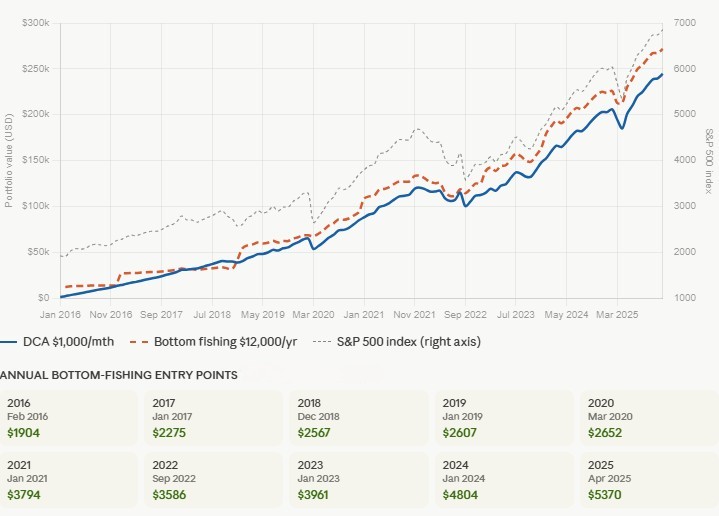
At the end of 10 years, the DCA portfolio stands at $244,607, a gain of 103.8%. For BF, it is $271,711, a gain of 126.4%
The average return over the 10 yrs between DCA and BF is 10.30% and 12.64% per annum. The result is surprisingly close and that is the most powerful lesson. Even with perfect hindsight of knowing exactly which month was the cheapest each year and buying there, the bottom fishing strategy produces a mere 2.34% more over the plain disciplined DCA. The entry cards below the chart show you just how demanding “perfect timing” really is: 2016’s bottom was February, 2018’s was December, 2020’s was March during the peak of COVID panic. No real investor consistently buys at those exact moments.
Dollar-cost averaging is simply the practice of investing a fixed amount of money at regular intervals. It can be monthly, quarterly, regardless of what the market is doing. Whether the market is up, down, or sideways, you invest the same amount. When prices are high, your fixed amount buys fewer units. When prices are low, it buys more. Over time, this naturally brings your average cost per unit lower than the average market price. The of watching the market or looking at market outlook is removed because you just need to stay consistent.
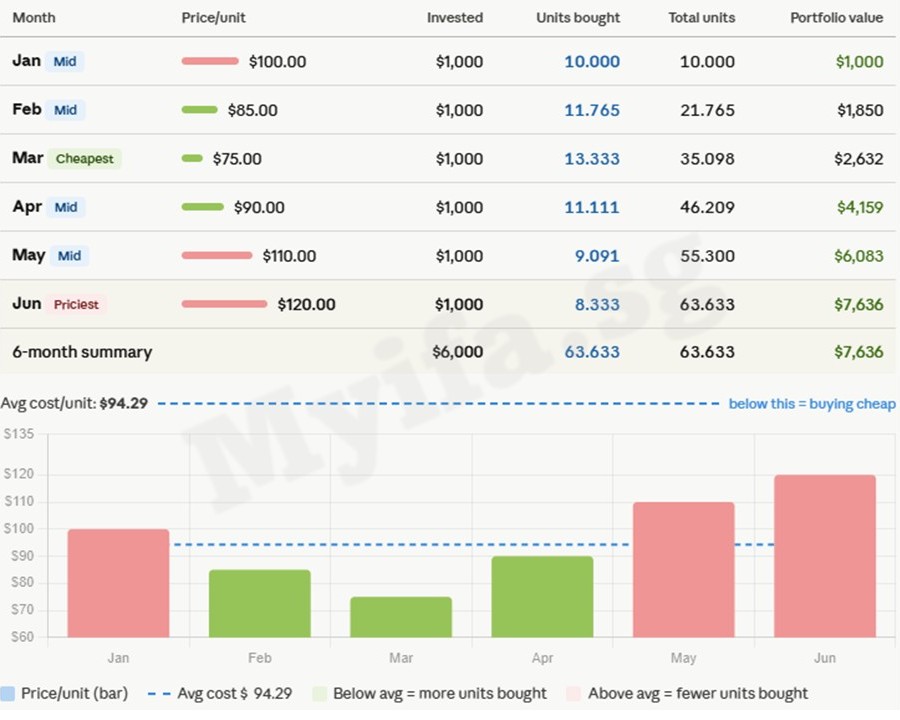
To illustrate the concept of DCA, we use a simple illustrative scenario where an investor invested $1,000 per month regardless the prices move up and down across 6 months.
The key insight is in the “Units bought” column. Because you invest a fixed $1,000 each month, the number of units you receive automatically adjusts with the price:
- In Jan, the price started at $100, your $1,000 bought 10.000 units – your first month
- In March, when the price fell to $75, your $1,000 bought 13.333 units – your best month
- In June, when the price rose to $120, your $1,000 only bought 8.333 units – your worst month
- You never had to think about it. The math did the work for you.
Because you naturally bought more when prices were low, your average cost per unit is $93.41( in this example). This average cost ends up lower than the simple average price of $96.67 across the 6 months. That gap is the entire magic of DCA. All your client needs to know is: the fixed amount buys more when it’s cheap, less when it’s expensive, automatically.
The green bars are months where we were buying cheap (below your average cost), red bars are months where we were buying at a premium. Even with two expensive months at the end, the overall result is a portfolio worth more than what we put in.This method of investing while is simple, it may seems boring to some investors and they may asked why should we invest when the price is high.
Every investor dreams of buying at the absolute lowest price, catching the market at its bottom and riding the wave up. This is called Bottom Fishing. It is the strategy of waiting for the market to fall to what you believe is its lowest point, then deploying a lump sum all at once to maximise gains on the recovery.
It sounds logical to buy low, sell high. But the hard truth is nobody consistently knows where the bottom is. In fact, we know when is the lowest point only on hindsight. Professional fund managers with teams of analysts and decades of experience regularly get this wrong. Retail investors, with full-time jobs and limited market access, get it wrong even more often.
When you are waiting for the bottom, you are also waiting on the sidelines with idle cash. Most of the time, we either catch the falling knife or miss out on any recovery that begins before we place our order.
From the chart & returns, Bottom Fishing looks like a better strategy but is that true?
Bottom fishing can outperform DCA under three specific conditions:
- There is a sharp, sudden crash (like 2020 or 2008)
- The investor has the cash ready and the courage to deploy it at the worst moment
- The market recovers strongly and quickly
All three must be true simultaneously. That is rare, and even rarer for the average investor to execute correctly. The chance of Bottom Fishing winning is in theory and DCA wins in the real world.
1. Nobody actually catches the bottom. Our chart used perfect hindsight which we knew exactly which month & day was cheapest. In reality, when March 2020 was happening, the news was catastrophic. Most investors prefer to hold cash because the market was so uncertain. Either they froze and do nothing or sold to cut loss.
2. Cash sitting idle is a hidden cost. Every month the bottom fisher waits, that $1,000 earns nothing. In a rising market like 2017 or 2021, that idle cash is a significant drag.
3. It is repeatable and scalable. We do not need a lump sum, market expertise, or courage. We just need to set up a monthly instruction and practice discipline to contribute regularly.
4. DCA is emotionless by design. It removes the two biggest enemies of investing i.e. Fear and greed.
In conclusion, most investors like to believe they can outsmart the market by waiting patiently on the sidelines, ready to strike when prices fall. It feels logical, even disciplined. But the reality is far less forgiving. We can see a dropping market but we can’t see the bottom, and fear rarely feels like opportunity in the moment. In my years of practice, equities funds dropped from -20% to -30% and some went as low as -50% during the Global Financial Crisis and Bonds funds also suffered -20%. This is where many hesitate, held by by fear, and ultimately miss the recovery. In contrast, Dollar-Cost Averaging works quietly in the background. It removes the need for perfect timing and replaces it with consistency. Month after month, it builds momentum ,not through brilliance, but through discipline. While bottom fishing may win in theory, in real life it is consistency that most often turns intention into results.
 My IFA@Sg